Allen Latta's Thoughts on Private Equity, Etc.
  • Allen's Blog
  • Blog Post Categories
  • Glossary of PE/VC Terms
  • Resources
  • About
  • Contact
  • Disclaimers

LP Corner: Private Equity Fund Performance - An Overview

1/20/2018

0 Comments

 
This one of a series of posts on fund performance metrics.  Other posts in this series include:
  • LP Corner: Private Equity Fund Performance – An Overview - This blog post.
  • LP Corner: Fund Performance Metrics – Multiples TVPI, DPI and RVPI
  • LP Corner: Fund Performance Metrics – Internal Rate of Return (IRR) – Part One
  • LP Corner: Fund Performance Metrics – Internal Rate of Return (IRR) – Part Two
  • LP Corner: Fund Performance Metrics – Public Market Equivalent (PME)
  • LP Corner: Fund Performance Metrics - Private Equity Fund Performance
  • LP Corner: Gross vs Net Returns

Introduction
How do LPs measure performance of a private equity fund?  It’s not a simple as one would think.  This post introduces a number of concepts, each of which will be discussed in more detail in future posts.
 
The following are the basic metrics used to evaluate fund performance:
  • Rate of return.  This is also called internal rate of return, or IRR.
  • Multiples.  These multiples include Total Value to Paid-in-Capital, Distributions to Paid-in-Capital, and Residual Value to Paid-in-Capital.
  • Relative performance.  This is performance relative to comparable funds (also called quartile performance).
  • Public market equivalent performance.  This is known as PME, and has a number of variants.
 
Each of the above performance metrics have positives and negatives.

To read more, please click on "Read More" to the right below.

Read More
0 Comments

LP Corner: The J-Curve

7/8/2017

2 Comments

 
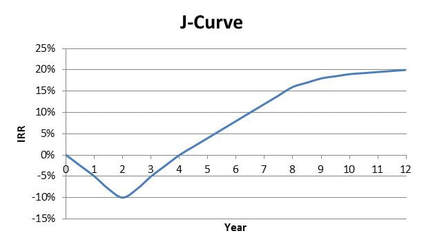
​First time investors in private equity funds are sometimes alarmed / confused / surprised to learn that their fund investment has a negative return in the early years of the fund’s life.  Then, to their relief, as the fund ages, the fund’s return increases.  This is known as the ”J-Curve” and it is a common phenomenon in private equity, particularly early-stage venture capital.  

​A simplified hypothetical representation is of the J-Curve is below:
Picture
To read more, please click on "Read More" to the right below.
Read More
2 Comments

LP Corner: Private Equity Fund Cash Flows from the LP Perspective

7/3/2017

1 Comment

 
​For investors that are new to investing in private equity funds (venture capital funds, growth equity funds and buyout funds), one area of confusion is often around how the fund cash flows work from the investor perspective.  This blog post attempts to explain this.
 
As an initial matter, it is important to understand that private equity funds are very different from mutual funds.  When an investor invests in a mutual fund, the investor will write a check on day 1 and at some point later in time will withdraw money from the fund.  Private equity funds operate on a very different basis - known as a "called capital" basis.  Let me explain.
​
To read more, please click on "Read More" to the lower right.

Read More
1 Comment

LP Corner: The Four Phases in the Life of a Private Equity Fund

6/24/2017

0 Comments

 
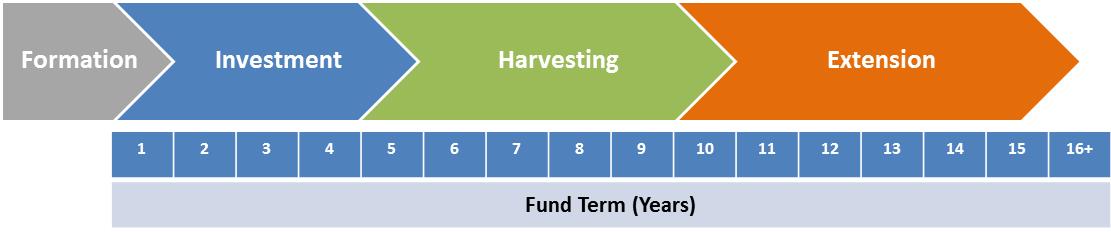
Investing in private equity funds is a long-term process.  Private equity funds have finite lives, unlike mutual funds.  Most private equity funds come to market with a 10 year term with up to two one-year extensions at the discretion of the manager.  This suggests a fund term of 10-12 years.  However, most funds exist for much longer than 12 years from the initial call of capital to final liquidation.

I view the life of a private equity fund as having four phases:
  • Formation;
  • Investment;
  • Harvesting; and
  • Extension.
 
The four phases of a fund’s life can be viewed graphically:
Picture
To read more, please click on "Read More" to the lower right.

Read More
0 Comments

LP Corner: On Committed Capital, Called Capital and Uncalled Capital

6/10/2017

1 Comment

 
The private equity world has a lot of terminology.  In a prior post, I discussed the structure of a private equity fund, and introduced the terms "limited partners" (or "LPs"), the "general partner" ( or "GP") and the "management company."  In this post, we'll explore fund "sizes" and a little bit of how investments in private equity funds work.

The "size" of a private equity fund is based on the total amount of money all investors 
commit to invest in the fund - known as "committed capital."  Because a private equity fund invests capital over time, the fund does not need all of the investors' money at the inception of the fund, and so the fund "calls" capital over time.  Private equity funds typically have initial terms of 10 years, but most of the new investing occurs during the first several years (usually 3-5 years) of the fund, known as the "investment period."  As a result, the fund calls the bulk of capital from the investors during this investment period.
​
​Let's use an example.

To read more, please click "Read More" to the lower right.

Read More
1 Comment

LP Corner: US Private Equity Fund Structure - The Limited Partnership

6/3/2017

0 Comments

 
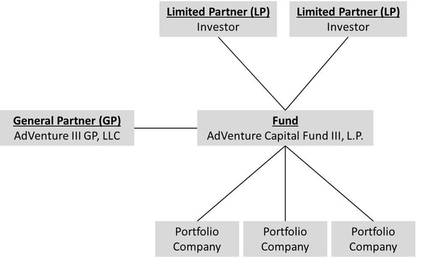
For investors new to investing in private equity funds, the mechanics of how funds work can be a bit confusing.  This post introduces the typical private equity fund structure that's used in the United States - the limited partnership.

Basic Limited Partnership Structure
In a basic limited partnership, there are several passive investors (known as "Limited Partners" or "LPs") and the manager of the fund, (known as the "General Partner" or "GP").  The diagram below illustrates this basic structure.
Picture
To read more, please click "Read More" to the right below.

Read More
0 Comments

LP Corner: Thoughts on GP Commitment

5/13/2017

4 Comments

 
This is one of a series of posts on fund terms.  Other posts include:
  • Management Fee
  • ​Carried Interest Overview
  • Carried Interest – Preferred Return and GP Catchup
  • GP Clawback
  • Management Fee Offsets
  • Key Person Clauses
  • No Fault Divorce
  • For Cause Actions
  • Should Venture Capital Funds have a Preferred Return Hurdle?

Private equity funds (buyout, venture capital and growth equity funds) are typically structured as limited partnerships, which have two types of partners: limited partners, or LPs, which are passive investors in the fund; and a general partner, or GP, which is the manager of the fund.  As I evaluate funds, one of the fund terms that receives special attention is the amount of money the GP will commit to the fund - which is called "GP Commitment", "GP Capital Commitment" or "GP Commit."  ​

To read more, please click "Read More" to the lower right.

Read More
4 Comments

LP Corner: What Are Buyouts?  Here's My Definition

4/22/2017

0 Comments

 
In a couple prior posts I've discussed my definition of venture capital and compared early-stage venture capital to growth equity.  Those posts can be found here:
  • What is Venture Capital? Here's My Definition
  • Venture Capital vs Growth Equity - A Comparison

In this post, I'll describe buyouts.

To read more, please click on "Read More" to the right below.
Read More
0 Comments

LP Corner: Venture Capital vs Growth Equity - A Comparison

4/15/2017

0 Comments

 
Private Equity is a term that has two common meanings: (1) as an asset class, which covers strategies such as venture capital, growth equity, buyouts, mezzanine financings and distressed debt; and (2) as a transaction type, where it really means buyouts.

There is often some confusion between venture capital, growth equity and buyouts, and this post explores the similarities and differences between venture capital and emerging equity.  More specifically, this post will explore the difference between early stage venture capital and growth equity.  Venture capital itself has a number of stages, from seed, to early-stage, to late-stage financings.  By comparing early-stage venture capital to growth equity, the differences are more clear and understandable.

Read More
0 Comments

LP Corner: What Is Venture Capital?  Here's My Definition

9/24/2016

0 Comments

 
I recently gave a talk about Venture Capital at UC Hastings College of Law (where I went to law school), and during the talk we went over the basics of venture capital.  It seemed to me that it would be a good exercise to write out the definition of venture capital as I see it.  So here goes…

To read more, please clilck on "Read More" to the right below.

Read More
0 Comments

Are We in A Venture Capital Bubble?  More Thoughts

2/9/2015

0 Comments

 
The debate of whether venture capital is in a bubble has been going on for some time now.  

On the "yes we are in a bubble" side, proponents point to: 
  • Huge amounts of money flowing to venture capital funds and companies; 
  • Sky-high valuations; 
  • Vast numbers of new startups;
  • Significantly high burn rates of many startups;
  • New entry into venture investing by corporations, hedge funds, mutual funds and others; 
  • The advent of incubators, crowdfunding and angel investors; and
  • The low interest rate environment.

On the "no we are not in a bubble" side, proponents point to:
  • Public tech companies trading at more reasonable valuations;
  • The vast market potential for the internet and e-commerce;
  • The amount of funds raised by traditional venture firms pales in comparison to the 1999-2000 bubble;
  • Venture-backed companies that are going public are more "real" (greater revenues and profiability) than companies that were going public in the 1999-2000 tech bubble; and
  • The healthy IPO and M&A environment are providing lots of liquidity;

Now a new article has added to the debate.  In "Silicon Valley Boom Unnerves Some Venture Capitalists" a few additional points were raised:
  • Venture capital moves in cycles and this cycle will end.  The question is when it will end.
  • There's a real war for technology talent, which leads to higher startup costs.
  • The funding environment is frothy, both for venture capital funds and for startup companies.

My take on this is that we are in a very healthy venture capital cycle, and that the peak of the cycle will likely occur after interest rates rise meaningfully.  When this occurs, valuations will have to come down, and then lots of companies will be under water from a valuation perspective.  This will lead to losses and the cycle will end and move toward correction.

What do you think?

Here are some links to prior posts on the bubble question:

http://www.allenlatta.com/allens-blog/is-venture-capital-in-a-bubble

http://www.allenlatta.com/allens-blog/fred-wilson-on-the-bubble-question

http://www.allenlatta.com/allens-blog/tech-bubble-andreessen-and-conway-say-no

http://www.allenlatta.com/allens-blog/tech-bubble-two-views
0 Comments

Fraud by Venture Capital Fund Managers?

6/21/2014

0 Comments

 
I have been involved in the venture capital industry for over 25 years, and it is the extremely rare case that managers of venture capital funds have been accused of fraud.  I'm of the view that the vast majority of venture capital fund managers are honorable people with strong sense of values and integrity, and it disappoints me when fraud is alleged.  However, when cases of fraud are alleged, it serves as a poignant reminder for venture capital fund investors to conduct thorough due diligence on fund managers before investing and to be vigilant after investing to identify any potential fraud.

Reuters recently reported in "Venture Capitalists Sues Former Boss, Now Fired, For Fraud" that G. Steven Burrill, founder of life science venture capital firm Burrill & Co. (the website was down at the time of this writing, but the link is www.burrillandco.com) has been fired from the firm he founded and sued for fraud.  If the allegations are proved true, this would mark a sad chapter in the career of this longtime biotech investor, and a sad moment for the venture capital industry.

I have seen the rare case of scandal or alleged misconduct among venture capital fund managers (primarily related to sex or drugs), and allegations of fraud are no less rare.  The following are a few of the reported fraud cases alleged against venture capital fund managers:
  • Earlier this year the SEC charged a venture capital fund manager with fraud by using fund assets to pay a fake front company controlled by the manager.
  • In 2011, the SEC alleged that a venture capital fund manager committed fraud in connection with a fund he promoted.
  • In 2009, the SEC filed a complaint alleging that a venture capital fund manager committed fraud in connection with raising a fund and operating as an unregistered broker-dealer.
  • In 2008, the SEC alleged that a former venture capitalists defrauded investors and using the money to buy a stake in a professional hockey team.
  • In 2008, a venture capital fund manager was convicted of defrauding investors of more than $20 million in connection with raising a fund and financing for a company.
  • In 2005, an accountant associated with a venture capital fund pled guilty to fraud in connection with the diversion of capital from a venture capital fund.
Unfortunately, fraud does occur, and the foregoing examples are again a reminder to be diligent and vigilant when investing in venture capital funds.

If you are aware of any other allegations of fraud or wrongdoing by venture capital fund managers, please let me know.

Link to Reuters story:  http://www.reuters.com/article/2014/06/20/us-venture-fraud-burrill-idUSKBN0EV01720140620


0 Comments

Some Thoughts on Venture Capital Returns

5/31/2014

0 Comments

 
I read an article recently that exclaimed that returns in the fourth quarter of 2013 for venture capital had exceeded equivalent returns from the public markets which hasn't happened very often since the internet bubble burst.  After reading the article, I felt that it missed the mark on venture returns, so here are some of my thoughts:
  • Venture capital returns should be measured over long terms.  Venture Capital is a long-term asset class, so the focus should be on long-term returns.  Most venture capital funds have a headline 10 year life (some are moving to 12 years) with two to three years in extensions, but the reality is that most funds take a lot longer to fully wind-down - 15-18 years in my experience.  Thus, the returns that I focus on are the 10 and 15 year returns.
  • Venture returns should exceed public market returns.  Venture capital (1) is a risky investment, (2) is an illiquid investment (generally speaking), and (3) has a long-term holding period (if held to maturity).  As a result, venture capital should provide a premium to public markets.  What should the return premium be?  In my experience, investors in venture capital limited partnerships (known as Limited Partners or LPs) look to have a premium of 300 basis points to 700 basis points (or more) over a public market index.  I lean to the 500 basis points premium.  What public market index should be used?  In my view, the Russell 2000 or Nasdaq seem to be the most logical indices but I know many LPs that use the S&P 500 or other indices.
  • Venture returns are unique to the investor.  While venture capital indices are interesting for high level analysis and showing industry trends, these indices can't be replicated by an investor and so each investor's experience will be different.  The vast majority of venture capital funds are private vehicles that have a limited number of investors.  Some funds are very selective as to their investors, for example, some funds have excluded public pension funds as investors because of freedom of information act issues.  The general public also can't typically invest in venture capital funds as most funds are limited to wealthy investors (accredited investors) who are invited to invest by the fund managers.
I hope these thoughts are useful.  Let me know if you have other thoughts.
0 Comments

Is Venture Capital in a Bubble?

4/10/2014

0 Comments

 
Is Venture Capital in a Bubble?  This is a question that I see in the press a lot recently, with most prognosticators taking the view that No, Venture Capital is not in a bubble.  Take, for instance, today's posting on Business Insider  "Venture Capital Funding Is Nowhere Near The Levels We Saw During The Dot-Com Bubble."  This articles summarizes recent Deutsche Bank research that concludes that there is no evidence of a technology bubble.  The article discusses that the total amount being invested in venture capital today is no where near the levels of the great technology bubble of 1999-2000, aka the Dot-Com Bubble.

My view is a little more nuanced, and is based on anecdotal evidence and conversations I've had with VCs and investors in venture capital funds.  I'm of the view that in general, we are not in a bubble (as compared to the Dot-Com Bubble), but we are in an elevated state of valuations in certain sectors.  We've recently seen some impressive acquisitions (Whatsapp, Oculus VR, etc.) at sky-high valuations, which suggest these sectors may have bubble-like characteristics.  I hear from VCs that initial investment valuations are very high in certain sectors, which makes investing difficult, but that given the high valuations now is a good time to be exiting investments.  The encouraging thing about this for me, who was active during the Dot-Com Bubble, is that there is a recognition now that valuations are high, versus the excuses I heard in the Dot-Com bubble about paradigm shifts etc. that were used to justify ever-increasing entry valuations.

So I don't think we are in a bubble overall today, but that we are in a period of elevated valuations and certain sectors have bubble-like characteristics.  This situation does bear close monitoring, as if venture capital fund raising levels spike up, then more money will lead to higher entry valuations and exits, which could easily lead us into a bubble.

Business Insider article: http://www.businessinsider.com/historical-venture-capital-funding-2014-4


0 Comments

Thoughts on Listed Private Equity

11/28/2013

0 Comments

 
There's an interesting post today on Seeking Alpha discussing listed private equity called "Listed Private Equity: From Skeptic To Believer" by Jessica Rabe and Robert J. Martorana, CFA.  Note that the article is behind a firewall, so you may have to register to read the entire article.  As an advisor to a listed private equity vehicle, I read this article with interest.

The authors describe listed private equity (LPE) as including "publicly traded companies that focus on private equity investments" and note that LPEs have many different strategies, and may be diversified by geography, styles and financing types.  It's an interesting article and worth a read, but I have some differing views than the authors.

In my view, LPEs offer certain benefits to a typical retail investor:
  • Access to a "restricted" asset class.  Typically, investors in private equity limited partnerships or in private companies must meet certain eligibility requirements (income and net worth) that many retail investors may not meet.  In this sense LPE vehicles may provide retail investors access to this restricted asset class.  Also, in the case of venture capital, many of the funds are invitation-only, and so an LPE may provide access to these highly sought-after funds.
  • Liquidity.  LPEs trade on public exchanges and so the shares are liquid, and retail investors can generally buy and sell shares with relative ease.  One big exception to this is that some LPEs have limited float and trading volumes, which may make trading more difficult and widen the bid-ask spreads.  
  • Access to an illiquid asset class.  Investments in private equity limited partnerships or directly in private companies have many restrictions on transfer, which make selling the investment very difficult and when it does occur, it will typically occur at a discount to the net asset value (NAV) of the investment.  LPEs provide retail investors with indirect access to venture capital and buyout funds or direct investments in private companies.

Transparency.  The authors of the article also list transparency as a benefit.  In my experience, this is not always the case.  An investment in a private equity fund or private company typically carries with it very strong confidentiality provisions.  Some funds even prohibit the disclosure of the name of the fund or the fact that an investment has been made.  LPEs that invest in these funds may in fact provide less information than if an investor were to invest directly in the fund or company.

Trading discounts.  The authors note that LPEs trade at discounts (or sometimes premiums) to the NAV.  This is something retail investors must consider carefully when evaluating an investment in LPEs.  For LPEs that invest in private equity funds, the range of discount can be very wide.  This discount could be due to the quality of the underlying investments, the leverage used by the LPE, over-commitment by the LPE, cash on hand, interest rates, and other market and macro-economic factors.  Currently LPEs on the London Stock Exchange focusing on investing in private equity funds (these are known as funds-of-funds) are trading at discounts ranging from 10% to 36%, with an average discount of 21%.

Types of LPEs.  There are many different types and styles of LPEs.  The main structures are funds-of-funds, direct investment vehicles, and managers.  Funds-of-funds typically invest in private limited partnerships of buyout and/or venture capital funds, and can focus on different geographies, etc.  Direct investment vehicles typically invest in private companies via buyouts, growth equity investments or venture capital investments.  There are also hybrids of funds-of-funds and direct investment vehicles.  Manager LPEs are typically the management companies of large private equity firms such as Blackstone or KKR.  Each of these different types of vehicles have differing characteristics that must be properly evaluated when making an investment.

LPE investing in LPEs?  To me, one of the reasons to invest in an LPE is to obtain access to buyout funds and hard-to-access venture capital funds that a retail investor could not do on their own.  But the LPE described by the authors appears to invest in other LPEs and has an expense ratio of 2.58%.  Maybe I'm confused here, but in my view, why would one pay a 2.58% fee to a vehicle that invests in other listed vehicles?  Based on the table provided in the article, one could easily replicate the holdings of the LPE at much lower cost.

In my view, LPEs can offer retail investors with access to a hard-to-access, hard-to-evaluate, illiquid asset class.  However, any investor in these vehicles must do their due diligence on the LPE itself, and the strategy employed, and must be aware of the risks involved in these investments.  Both JP Morgan Cazenove and Numis Securities in London have research groups that cover LPEs and I would recommend anyone interested in these vehicles to contact them for more information on the LPE universe.

Link to Seeking Alpha article:  
http://seekingalpha.com/article/1867791-listed-private-equity-from-skeptic-to-believer


0 Comments

LP Corner: An LP's Advice to GPs on Annual Investor Meetings

10/28/2012

1 Comment

 
As an investor in private equity funds (primarily venture capital funds and mid-market buyout funds), I have been to many, many investor meetings.  I've seen great meetings, good meetings and some meetings that could have been better.  Over time, I've developed some thoughts on how private equity fund managers can improve GP-LP relations with their annual meetings.  Here are my thoughts for GPs as they plan their investor meetings:
  1. Investor meetings are important for both GPs and LPs.  For LPs, this is our best time (and often only time during the year) to speak with several members of the investing team and to develop these important relationships.  For GPs, this is your best time to cement the relationships you have with your LPs in a very favorable environment.
  2. Have an ANNUAL meeting.  There are some funds that have meetings on less than an annual schedule.  Many LPs conduct an annual review of funds and the underlying portfolio portfolio companies.  The best way to understand the firm, the funds and the underlying portfolio companies is by meeting with the GP on an annual basis.  
  3. Have the meeting soon after the release of the audited financial statements.  As an LP, I want the best information I can get about the fund performance and the best information is soon after the release of the annual report.  April and early May are good months for investor meetings.
  4. Invite ALL investors to the investor meeting.  As I mentioned, the investor meeting is the best opportunity an LP has to speak with several members of the investing team.  This is really critical for LPs to develop the relationships with the investing team and to understand the strategy better.  A GP that excludes an LP from an investor meeting because the LP is "too small" is sending a terrible message to the LP that they just aren't important.  That's bad for everyone.
  5. The best days for annual meetings are Tuesday, Wednesday and Thursday.  Many LPs (especially foreign LPs) will travel long distances to attend the annual meeting.  Having to travel on weekends is painful for most people, and so scheduling investor meetings for Tuesday, Wednesday and Thursday helps with travel schedules.  Also, if you have foreign LPs, check the holidays for their countries before scheduling the annual meeting.  For example, if a US fund has several key LPs that are from France, these LPs may not be able to attend if the meeting is held on July 14, which is Bastille Day.  Once the meeting date is scheduled and invitations sent, don't change the date of the meeting unless it is an emergency.  Many LPs book non-refundable flights and hotels, and so will suffer economic losses if the date is changed.
  6. Provide handouts and electronic copies of the meeting materials.  Provide LPs with printouts of the presentations for the investor meeting.  It is really helpful to have the presentations so notes can be written in the margins to add the color commentary to the slides.  It is this commentary that sometimes is really insightful.  Also, provide LPs with electronic copies of the slides, either on your website or on a USB key.  Some funds have in the past have not provided LPs with printouts or electronic copies of the presentations on the grounds of confidentiality.  However, LPs have signed confidentiality agreements either in the limited partnership agreement or separately, and GPs can have LPs sign a confidentiality statement at the investor meeting in order to receive the handouts.  Not providing handouts sends LPs a message that you don't trust us.  That's a bad message to send.
  7. Provide substance over style.  I'm less concerned about activities and celebrity speakers than I am about learning about the firm's dynamics, industry developments, fund performance and portfolio company progress.  Dazzle me with substance and don't worry about activities and celebrity speakers.
  8. Encourage questions.  Questions from the floor are often the best way to learn what is going on at the firm, fund(s) and portfolio companies.  Encourage questions during the presentations or open the floor to questions after each session.
  9. Provide performance metrics.  What LPs want to know is how the fund is doing.  Providing net IRR information, multiple information and quartile performance helps LPs to understand how the fund is doing.  Also, have a discussion of the firm's valuation guidelines - when are discounts taken, use of comps v. DCF v. prior round valuation v. recent transactions.  All of these are helpful for LPs to understand how conservative the valuations are.
  10. Give the bad news.  If the fund or portfolio company isn't doing well, address that in the meeting. Its better to address bad news head-on than hide it.
  11. Firm overview.  It's really helpful for the GP to re-state the investment strategy and how the firm is situated in the industry.  It's also important to discuss changes at the firm.  Questions such as:  What are the firm's core strengths?  How does the investment strategy provide outsized returns?  How is the firm differentiated from its peers?  What has happened at the firm over the past year?  You'd be surprised that some firms neglect this important aspect of the meetings.
  12. Industry overview.  I like to hear the partners' take on the industry - past, present and future.  It is very helpful to hear what has changed in the past year, how the environment is today and where the partners think the industry is heading in the future.
  13. Fund review.  Provide a detailed analysis of the fund's performance and changes since the last year.  Fund performance metrics (see above) are key.  Also provide an assessment of the performance of the portfolio companies.  For private portfolio companies, metrics such as revenue and revenue growth, EBITDA and EBITDA growth, exit timing and type, comparable companies, etc. are all helpful for LPs to understand the performance and valuation of the portfolio companies.
  14. Capital markets presentation.  It's also helpful to hear a capital markets expert (investment banker) discuss the M&A and IPO environment.
  15. Portfolio company presentations.  I am a big fan of portfolio company presentations, especially when they are preceded by the responsible investing partner discussing the investment thesis and the deal.
  16. Reception and dinner.  I'm also a fan of receptions after the meeting and sit-down dinners.  It's a great way for LPs to interact with the investment team in a more informal setting.
  17. Ideal agenda.  Here's my ideal agenda:  
Agenda:
  • Introduction and Firm Update.  An update on what has happened at the firm and funds in the past year.
  • Industry Review and Outlook.  A review on developments in the industry over the past year, the current state of the industry, and projections for the future.
  • Fund Update.  Performance metrics, calls, distributions, investments, portfolio companies review, etc.
  • Capital Markets Overview.
  • Portfolio company presentations.
  • Reception and dinner.
I hope these thoughts are useful for GPs.  I welcome any additional thoughts from GPs or LPs on how investor meetings can be more productive.

Related Posts
Fundraising Tips for Emerging Managers 
http://www.allenlatta.com/allens-blog/fundraising-tips-for-emerging-managers

Emerging Manager Fund Presentations From an Investor's Perspective
http://www.allenlatta.com/allens-blog/emerging-manager-fund-presentations-from-an-investors-perspective

​Compelling PE Roadshows: The Investor Perspective
http://www.allenlatta.com/allens-blog/compelling-pe-roadshows-the-investor-perspective
​
1 Comment
Forward>>
    About this Blog

    This Blog is a collection of thoughts on a variety of topics of interest to me, including:
    • Private Equity
    • Buyouts
    • Growth Equity
    • Venture Capital
    • Corporate Finance
    • Investment Banking
    • IPOs
    • M&A
    • Technology
    • Economics
    • Law
    I hope you find this blog of interest.
    View my profile on LinkedIn

    Categories

    All
    Anti-Dilution
    Berlin
    Board Of Directors
    Brazil
    Buyouts
    California
    China
    Cleantech
    Corporate Finance
    Corporate Venture Capital
    Crowdfunding
    Dilution
    Dividend Recap
    Economics
    Emerging Managers
    Endowments
    Entrepreneurship
    Europe
    Fund Terms
    General
    Growth Equity
    Healthcare
    India
    Innovation
    Investment Banking
    Ipo
    Israel
    Law
    Legal
    Libor
    Life Sciences
    Listed Private Equity
    London
    Los Angeles
    LP Corner
    M&A
    Mexico
    New York
    Pensions
    Politics
    Private Equity
    Public Stocks
    San Francisco
    Secondaries
    Secondary Exchanges
    Silicon Valley
    South America
    Speaking
    Stock Market
    Stock Options
    Tax
    Technology
    Travel
    United Kingdom
    Valuation
    Venture Capital
    Venture Capital Deal Terms
    Webinars


    Archives

    June 2026
    April 2025
    October 2021
    August 2021
    July 2021
    April 2021
    March 2021
    February 2021
    January 2021
    December 2020
    November 2020
    October 2020
    September 2020
    August 2020
    July 2020
    June 2020
    May 2020
    April 2020
    February 2020
    December 2019
    November 2019
    October 2019
    September 2019
    August 2019
    July 2019
    June 2019
    April 2019
    March 2019
    February 2019
    January 2019
    December 2018
    November 2018
    October 2018
    September 2018
    August 2018
    July 2018
    June 2018
    May 2018
    April 2018
    March 2018
    February 2018
    January 2018
    December 2017
    November 2017
    October 2017
    September 2017
    August 2017
    July 2017
    June 2017
    May 2017
    April 2017
    March 2017
    February 2017
    January 2017
    December 2016
    October 2016
    September 2016
    August 2016
    July 2016
    June 2016
    May 2016
    April 2016
    February 2016
    January 2016
    November 2015
    October 2015
    July 2015
    June 2015
    May 2015
    April 2015
    March 2015
    February 2015
    January 2015
    December 2014
    November 2014
    October 2014
    September 2014
    August 2014
    July 2014
    June 2014
    May 2014
    April 2014
    March 2014
    February 2014
    January 2014
    November 2013
    October 2013
    September 2013
    August 2013
    July 2013
    June 2013
    May 2013
    April 2013
    February 2013
    January 2013
    December 2012
    November 2012
    October 2012
    September 2012
    August 2012
    July 2012
    June 2012
    May 2012
    April 2012
    March 2012
    February 2012
    January 2012
    December 2011
    November 2011
    October 2011


    Copyright Notice:

    ​All original works on this site are 
    © Allen J. Latta. All rights reserved.  Neither this website nor any portion thereof may be reproduced or used in any manner whatsoever without the express prior written permission of Allen J. Latta.

    LP Corner® is a registered trademark of Campton Private Equity Advisors.  Used with permission.

    DISCLAIMER:  Readers of this Blog are not to construe it as investment, legal, accounting or tax advice, and it is not intended to provide the basis for the evaluation of any investment.  Readers should consult with their own investment, legal, accounting, tax and other advisors to the determine the benefits and risks of any investment.

    Private equity investments involve significant risks, including the loss of the entire investment.

    This Blog does not constitute an offer to sell or the solicitation of an offer to buy any security.

Powered by Create your own unique website with customizable templates.